You Are the Architect. AI Is the Executor
by Michael Gaio
AI can write code now. That part is solved.
What's not solved — and what matters more than ever — is designing software that actually works. Not just runs. Works. Coheres. Holds up under change.
I've been building with AI across dozens of projects over the past few years. The pattern is consistent: AI doesn't remove the need for software engineering — it amplifies it. A weak system doesn't fail slowly anymore — it collapses fast. A strong system becomes something else entirely.
That's the real shift. And most developers haven't felt it yet.
TL;DR
- — AI amplifies your engineering: weak systems fail faster, strong ones compound
- — The bottleneck shifted from writing code to designing systems
- — Six failure modes: misalignment, language breakdown, no feedback loop, too much too fast, shallow architecture, cognitive overload
- — Fix: align before coding, define shared vocabulary, build in phases, design deep modules
- — Your role is architect. AI is executor. That's a workflow, not a metaphor.
How I Got Here
I started using AI for coding in 2022. Mostly simple stuff — Python utilities, small integrations, basic automation. Useful, but limited.
Then in late 2024, AI IDEs started gaining real traction. Cursor, Windsurf, the whole wave. The promise was compelling: describe what you want, and the system builds it. So I went all in.
Things broke quickly.
Projects would start clean, then degrade. Codebases became tangled. Changes introduced unexpected failures. The more I leaned on AI without structure, the worse the system got. I was generating software faster — and losing control of it at the same time.
So I stepped back.
In 2025, I rebuilt my approach from the ground up. Slower. More deliberate. Specification before execution. Structure before code. That's when things started to click.
My current workflow is centered around Claude Code in VS Code and the terminal. But the tool isn't the point. The system is.
The insight I kept arriving at: AI didn't fail. My approach to using it was incomplete.
The Bottleneck Has Moved
Before AI, writing code was the bottleneck.
Now, writing code is the easiest part. The bottleneck is clarity, alignment, architecture, feedback.
In other words: system design.
AI is a force multiplier — it dramatically accelerates execution. But it doesn't fix bad thinking. It amplifies it. This is why software fundamentals matter more now than they did before. The craft shifted upstream.
Six Failure Modes in AI-Driven Development
After enough projects, the failure modes become recognizable. Here's how I see them — and how I address each one.
1 — Misalignment
The AI builds the wrong thing. This is the most common failure, and it has nothing to do with the AI. It happens when there's no clear design concept before generation begins.
My rule: I don't write code until there's alignment.
In practice, that means a structured pre-implementation phase I call /align. I introduce the problem, explicitly pause execution, and we work through the concept — constraints, tradeoffs, edge cases — until the direction is unambiguous. Only then do we move.
This single habit eliminates the majority of wasted cycles.
2 — Language Breakdown
The AI becomes inconsistent — using terms loosely, generating code that reflects ambiguity in the prompt rather than precision in the domain.
The fix is domain modeling. For every non-trivial project, I maintain a DOMAIN-LANGUAGE.md file that defines key terms, concepts, and relationships. Both I and the AI reference it constantly. It's the shared vocabulary of the system.
This is more than just documentation. It's a forcing function for clear thinking.
3 — No Feedback Loop
The code runs — but not correctly. Or worse, it almost works, which is harder to detect.
The underlying issue is treating development as linear rather than evolutionary. I orient around a simple cycle:
attune → act → reflect
In code: align, build, test and evaluate. Then repeat.
In practice: strong types, early tests, careful diff review, behavior validation — not just syntax. Every change feeds the next cycle. The system gets smarter with each loop.
4 — Too Much, Too Fast
AI generates large amounts of code before anything is validated. This produces fragile systems and hidden failures that compound.
Even with a complete plan, I build in phases:
- — define the architecture
- — implement a small slice
- — test and stabilize
- — move to the next layer
Speed without validation creates instability. The phase structure forces validation into the process.
5 — Shallow Architecture
AI tends toward shallow, fragmented code. Many small pieces, weak boundaries, hard to reason about at scale.
The antidote is designing around what I think of as deep modules — components with simple interfaces and contained internal complexity. The interface is what matters. Once it's defined clearly, I can hand most internal implementation to the AI. But the interface design is mine.
6 — Cognitive Overload
This one doesn't get discussed enough.
AI dramatically increases output — which also increases mental load. Without structure, both you and the AI lose track of the system. Context degrades. Decisions become inconsistent.
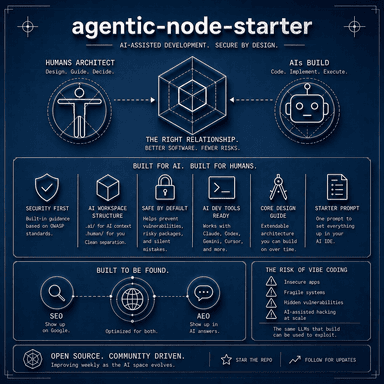
To manage this, I maintain a structured .ai/ directory at the root of every project:
.ai/
  AGENTS.md
  docs/
    specs/
    security/
    ARCHITECTURE.md
    DECISIONS.md
    ROADMAP.md
    SCHEMA.md
    STEERING.md
    TASKS.md
  DOMAIN-LANGUAGE.md
AGENTS.md tells the AI how to navigate the project. docs/ holds architecture, decisions, schema, tasks, and roadmap. DOMAIN-LANGUAGE.md lives at the root — it's a first-class artifact, not buried in docs. I also keep a .human/ directory for half-formed ideas not yet ready for AI consumption.
This separation reduces noise and keeps the system coherent for both of us. I packaged this structure into a public repo — agentic-node-starter — for anyone who wants a starting point.
How I Actually Work Now
My workflow is structured, but not rigid. It looks roughly like this:
- 1 — align on the problem and design
- 2 — define interfaces and module boundaries
- 3 — create a plan if the scope warrants it
- 4 — implement in phases
- 5 — test and evaluate continuously
- 6 — refactor toward clarity
AI is involved at every step. We think together. But once aligned, the AI handles most of the implementation.
My role has shifted toward design, validation, and decision-making. That's a fundamentally different job than just writing code. And it's a better one.
The Deeper Point
Before AI, leverage came from writing code.
Now, leverage comes from designing systems. AI is the executor. You are the architect.
That's not a metaphor — it's a workflow.
The Separation Is Already Happening
AI is not replacing developers — it's separating them.
On one side: people who generate 'vibe' code. On the other: people who design systems. The gap between those two is growing fast.
The developers who will matter in the next five years are the ones who can hold a system in their mind — its structure, its language, its constraints — and bring it to life with precision.
That's not a new skill. Systems architecture is a classic discipline, now becoming central again.
If you want to start working this way, the agentic-node-starter repo gives you the full project structure described in this article — the .ai/ directory, agent directives, domain language scaffolding, security measures, and more — ready to clone and adapt.

Michael Gaio
michaelgaio.devSenior Software Developer & AI Product Engineer with 25+ years of experience. I build AI-enabled products, agentic systems, intelligent workflows, and full-stack applications.
Frequently Asked Questions
What is the architect-executor model for AI development?
The architect-executor model separates roles: the human defines system structure, interfaces, and constraints; the AI handles implementation within those boundaries. The developer stops writing code and starts designing the system the AI will build.
How do I prevent AI from generating bad code?
Define alignment before writing code, maintain a DOMAIN-LANGUAGE.md for shared vocabulary, and build in phases with continuous validation. Most bad AI-generated code traces back to an unclear specification, not a capability limit.
What is the biggest failure mode in AI-assisted software development?
Misalignment — starting code generation before the design concept is clear. No amount of AI capability compensates for an unclear specification. Establish alignment before writing a single line.
Should developers still learn software architecture in the AI era?
Yes — architecture matters more, not less. AI amplifies execution speed, which means weak architecture collapses faster and strong architecture compounds faster. The craft shifted upstream: from implementation to design.
Keep going
Explore more writing, see what I've built, or reach out if you're working on something in this space.