Raw Intelligence vs Designed Systems
by Michael Gaio
AI is already helping people in psychotherapy.
Over the past few months, I've spoken with several psychotherapists who've all noticed the same thing: their clients are already using ChatGPT and Claude, and in many cases getting real value from doing so.
The pattern is worth paying attention to. Because while the value is real, the experience delivering it is mostly unstructured — and unstructured AI leads to inconsistent outcomes.
Sometimes it helps. Sometimes it confuses. Sometimes it goes nowhere.
The difference isn't the intelligence. The difference is the system.
TL;DR
- — Raw AI intelligence produces inconsistent outcomes without structure
- — The problem is AI UX: unstructured interaction lacks sequence, constraints, direction
- — AI becomes a delivery layer for human frameworks, not a replacement for them
- — Designed systems create outcomes; raw intelligence only generates possibilities
- — Mythic Path: a concrete example of guided AI over open-ended chat
The Problem with Unstructured AI
Most AI tools today are built around open-ended interaction.
You ask a question. You get a response. You follow up.
No defined pattern, progression, or constraints. No structure guiding the interaction.
The analogy that keeps coming to mind: talking to a highly intelligent person with no method. They can say useful things — but they're not guiding you anywhere in particular.
This is fundamentally an AI UX problem, or more precisely, an AX (AI Experience) problem. The intelligence is there, but experience isn't designed.
What Raw Intelligence Actually Is
Models like ChatGPT and Claude represent something genuinely new: raw intelligence — highly capable, flexible, and responsive.
But raw intelligence alone doesn't produce reliable outcomes.
Without structure, the same input leads to completely different results. The system carries no memory of intention, no defined direction, and no consistent process.
This pattern is familiar from software development. You can generate code quickly — but without structure, the system degrades. You can ship features — but without design, the product breaks down. AI doesn't resolve this. It amplifies it.
What Actually Works
What works isn't more intelligence.
What works is designed systems.
Systems that introduce:
- — structure
- — sequence
- — constraints
- — intentional progression
Instead of open-ended interaction, you define where the user starts, how they move forward, what each step is designed to reveal, and what the outcome should be.
Good UX has always been about guiding users toward meaningful outcomes. With AI, that responsibility increases — because the system is no longer deterministic — it's generative. The design layer matters even more.
Good AX isn't about freedom. It's about guided intelligence.
A Concrete Example: Mythic Path
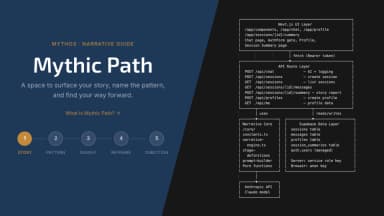
To explore this directly, I built an application called Mythic Path.
Mythic Path is a guided AI experience based on principles of narrative therapy. Instead of open-ended chat, the user moves through a defined process:
- — story → the narrative you're carrying
- — pattern → what's actually going on
- — insight → where you've had agency
- — reframe → a more complete narrative
- — direction → one clear next step
At each stage, the system constrains the interaction and focuses the output. By the end, it generates a structured summary — a narrative map of the user's current situation and next direction.
The difference from open-ended AI chat is immediate. Users don't just “talk” to the system. They move through something — with progression, clarity, and an outcome. This isn't a replacement for therapy. It's a demonstration that AI can be designed to align with an existing framework, and when it is, the experience changes substantially.
Why Structure Changes Everything
When you introduce structure, several things happen:
- — ambiguity decreases
- — focus increases
- — the system becomes directional
- — outputs become consistent
The AI is still doing the work. The system is shaping how that work happens.
The principle is the same as in software architecture: you don't rely on raw capability. You define boundaries, interfaces, and flow. Within that structure, the system becomes reliable.
The Bigger Shift
A broader pattern is becoming clear: AI as a delivery layer for human frameworks.
AI is not replacing expertise — but extending it.
- — a therapist's process becomes a guided system
- — a coach's method becomes an interactive experience
- — a consultant's framework becomes a decision engine
The value is no longer just in the knowledge. It's in how that knowledge is structured and delivered.
Where This Is Going
Most AI applications today still rely on the user to figure out how to interact with the system. That doesn't scale.
The next wave of AI products will look different:
- — structured
- — guided
- — outcome-oriented
Less like chat interfaces, and more like systems.
The Point
AI is not the product.
Raw intelligence is everywhere now. The product is the system built on top of it.
The difference between something that feels impressive and something that actually works is design.
Raw intelligence generates possibilities. Designed systems create outcomes.

Michael Gaio
michaelgaio.devSenior Software Developer & AI Product Engineer with 25+ years of experience. I build AI-enabled products, agentic systems, intelligent workflows, and full-stack applications.
Frequently Asked Questions
What is the difference between raw AI intelligence and a designed AI system?
Raw AI intelligence refers to models like ChatGPT or Claude in their default state — open-ended, flexible, and capable, but without a defined path or outcome. A designed AI system wraps that intelligence in structure: sequence, constraints, and intentional progression that guide the user toward a specific result. The intelligence is the same; the experience and outcomes are fundamentally different.
What is AI UX and why does it matter?
AI UX — or AX (AI Experience) — is the practice of designing how users interact with AI systems. Unlike traditional UX where flows are deterministic, AI UX must account for generative, variable outputs. Without intentional design, users are left to self-direct an interaction with no defined structure, which produces inconsistency. Good AI UX introduces direction, constraints, and clear outcomes.
What is Mythic Path?
Mythic Path is a guided AI experience built on principles of narrative therapy. Instead of open-ended chat, it walks users through a structured five-stage process — story, pattern, insight, reframe, and direction — generating a narrative summary of their current situation and a clear next step. It demonstrates how structured AI design produces more consistent and meaningful outcomes than unstructured interaction. Visit mythicpath.mythos.io.
How do you design a guided AI experience?
Start by defining the outcome you want the user to reach. Work backwards: what stages lead to that outcome? What does the user need to contribute at each stage? What should the AI output at each step? Structure the interaction as a sequence with defined inputs, outputs, and constraints at every step. The design determines the experience — not the model.
Keep going
Explore more writing, see what I've built, or reach out if you're working on something in this space.